MLOps Architect Vladyslav Haina on Why Emotional AI Fails Without Real-Time Infrastructure
The Lead MLOps & Cloud Architect explains how event streaming, vector databases, and production observability determine whether emotional AI applications deliver genuine understanding or expensive illusions.
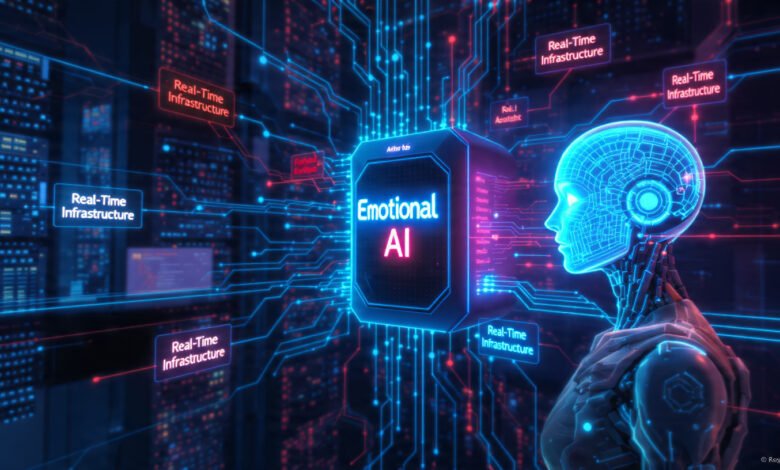
When Spotify’s recommendation engine suggests a song, latency of a few seconds doesn’t matter. When an emotional AI application detects user distress and delays its response by those same seconds, the moment has passed. The user needed support at 2:47:33 AM. The system responded at 2:47:36 AM. In emotional computing, three seconds is an eternity.
This latency problem—invisible in demos, catastrophic in production—surfaced repeatedly at DreamWare Hackathon 2025, where 29 teams spent 72 hours building applications promising to “engineer the surreal.” Projects offered emotion-reactive music, AI companions that remember feelings, and interfaces that shift based on psychological state. Vladyslav Haina, a Lead MLOps & Cloud Architect specializing in real-time AI infrastructure, evaluated these submissions knowing exactly where the beautiful demos would break.
“Most teams built request-response systems,” Haina observes. “User sends input, system processes, system responds. That architecture cannot support real-time emotional awareness. The system only knows what you feel when you explicitly tell it. It cannot observe you continuously. It cannot detect distress from typing patterns or response latency. It waits for you to ask for help instead of noticing you need it.”
The Living Dreamspace: A Case Study in Missing Infrastructure
The DreamWare submission “The Living Dreamspace” promised music that reacts to user emotional states inferred from typing patterns. The concept requires continuous observation—every keystroke analyzed, emotional state updated in real-time, musical parameters adjusted accordingly. The demo impressed judges with its creative vision.
The infrastructure to deliver that vision at scale requires event streaming architecture. Every keyboard event must publish to a message broker. A stream processor must maintain running emotional assessments. The music generation service must subscribe to emotional state changes and respond within milliseconds. Without this infrastructure, the system can only react to completed messages, not ongoing emotional expression.
“Kafka and Flink solve exactly this problem,” he explains, referencing the streaming technologies deployed in production systems. “Kafka captures events continuously. Flink processes them in real-time with stateful computations—maintaining that running emotional assessment across events. The architecture exists. It’s proven at massive scale. But hackathon teams default to REST APIs because that’s what tutorials teach.”
The gap between “The Living Dreamspace” demo and production deployment isn’t feature development—it’s infrastructure transformation. The creative vision requires architectural patterns the team likely never encountered.


Consider the scale implications. A music application with 10,000 concurrent users, each generating keyboard events at 5 events per second, produces 50,000 events per second. Each event must be processed, emotional state must be updated, and music parameters must be adjusted—all within latency budgets measured in tens of milliseconds. Without streaming infrastructure designed for this throughput, the system either drops events (losing emotional signal) or backs up (destroying real-time responsiveness). The beautiful demo becomes unusable at scale.
ECHOES and the Vector Database Problem
“ECHOES” created an AI-powered emotional sanctuary using GPT-4 to generate therapeutic narratives. The project earned recognition for “exceptional artistic depth and emotional sophistication.” It also faces a fundamental memory problem that becomes apparent only with sustained use.
How does ECHOES remember that a user mentioned work anxiety three weeks ago? How does it connect that historical context to current conversation about sleep problems? Traditional databases can store the text, but retrieving emotionally relevant history requires more than keyword matching.
“Vector databases solve this through embedding similarity,” he explains. “You convert emotional expressions to high-dimensional vectors. Retrieval becomes: find past expressions most similar to current emotional state. The user feeling anxious now retrieves past anxiety episodes—even if they used completely different words. That’s genuine emotional memory, not text pattern matching.”
His production work includes RAG (Retrieval-Augmented Generation) pipelines using vector databases like Pinecone, Weaviate, and Milvus. The same infrastructure powering enterprise knowledge retrieval enables emotional continuity in AI companions. Without it, each session starts fresh, or worse, the system retrieves irrelevant history based on superficial text matches.
“”ECHOES could retrieve a past conversation about ‘feeling stressed about deadlines’ when the user mentions ‘overwhelmed by responsibilities’—semantically similar even though no words match. That’s what emotional memory should feel like. But it requires vector infrastructure most hackathon projects don’t implement.”
The operational complexity compounds over time. Vector indices grow as users accumulate emotional history. Query latency increases without proper index maintenance. Storage costs scale with embedding dimensions and retention policies. Production systems require automated index optimization, tiered storage strategies, and monitoring for query performance degradation. The hackathon prototype that queries a few hundred vectors performs differently than a production system querying millions.”
DreamGlobe: When Real-Time Coordination Fails
“DreamGlobe” enables users to share dreams on a global map with AI voice interaction. The voice feature orchestrates music pausing, speech-to-Gemini processing, Google TTS synthesis, and music resumption. This multi-modal coordination impressed judges—and represents exactly the orchestration challenge that production systems must solve.
“That’s four services that must coordinate in real-time,” he notes. “Music must pause before speech recognition starts. Gemini must complete before TTS begins. TTS must complete before music resumes. Any latency spike in any service breaks the experience. Users hear music over their own voice, or silence where response should be.”
Production systems handle this through event-driven choreography with guaranteed ordering and timeout handling. Services communicate through message queues with dead-letter handling for failures. Observability systems track latency at each step, alerting when coordination degrades.
“In the demo, everything works because the developer controls conditions. In production, Gemini has a latency spike during peak hours, and suddenly the orchestration fails for thousands of users simultaneously. The infrastructure to handle that—graceful degradation, fallback responses, queue-based coordination—is what separates demos from products.”
The Neural AfterLife: Memory Persistence at Scale
“The Neural AfterLife” proposed preserving memories across a digital existence—an ambitious vision requiring infrastructure that most applications never consider. How do you store decades of emotional history? How do you retrieve relevant memories from millions of entries? How do you ensure memories persist reliably across infrastructure changes?
“This is a distributed systems problem disguised as a creative application,” he observes. “You need durable storage that survives hardware failures. You need indexing that scales with memory accumulation. You need backup and recovery procedures for data that users consider irreplaceable. Losing someone’s emotional history isn’t like losing their shopping cart—it’s losing part of their identity.”
His experience with multi-cloud architecture across AWS, GCP, and Azure directly applies. Production systems use cross-region replication, automated failover, and point-in-time recovery. The same patterns that protect enterprise data must protect emotional archives—arguably with even more care, given the personal significance.
“The hackathon version probably uses a single database instance. Production requires geographic redundancy, encryption at rest, and disaster recovery tested regularly. The creative vision is beautiful. The infrastructure to honor that vision requires engineering discipline that extends far beyond the demo.”
Observability: Knowing When Emotional AI Fails
Production AI systems require observability that hackathon prototypes lack entirely. The production stack—Prometheus for metrics, Grafana for visualization, OpenTelemetry for distributed tracing—serves purposes specific to emotional AI deployment.
“Emotional AI fails silently,” he explains. “The model returns a response. The response seems coherent. But the emotion detection was wrong, so the response is inappropriate. Without monitoring model confidence scores, output distributions, and user engagement patterns, you don’t know the system is failing until users complain—or stop using it.”
For wellness applications, this observability becomes safety-critical. A model generating responses to users in emotional distress must be monitored for harmful patterns. Confidence scores that drop below thresholds should trigger human review. Anomalous outputs should alert on-call engineers.
“”DearDiary builds an emotional analytics dashboard showing ‘your anxious Mondays.’ That same data could power operational dashboards showing ‘model confidence dropped 40% for anxiety-related inputs.’ The infrastructure for user insights and operational monitoring overlaps significantly. Teams that build one can build the other.”
The monitoring requirements extend beyond traditional application metrics. Emotional AI systems need tracking for model drift—detecting when the emotion classification model starts producing different distributions than during training. They need fairness monitoring—ensuring the system performs consistently across user demographics. They need safety monitoring—detecting when responses approach harmful territory. Traditional APM tools don’t provide these capabilities. Production emotional AI requires MLOps-specific observability that most teams don’t know exists.”
MCP Agents: The Orchestration Layer Emotional AI Needs
Recent developments in Model Context Protocol (MCP) agent systems offer architectural patterns directly relevant to emotional AI. Rather than simple prompt-response interactions, MCP agents observe context, plan actions, execute tools, and maintain state—exactly what sophisticated emotional applications require.
“An MCP-based emotional companion doesn’t just generate text responses,” he explains. “It can observe user distress, decide to check past successful interventions, retrieve relevant history from vector storage, personalize its approach based on what worked before, and schedule follow-up checks. That’s agent behavior, not chatbot behavior.”
His work includes infrastructure and security for MCP agent systems—agent orchestration, skill execution, and LangGraph implementations. The same patterns enabling enterprise AI agents apply to emotional AI companions, with additional considerations for the sensitive nature of emotional data.
“The security implications compound. Agent systems make multiple model calls per interaction. Each call is a potential data exposure. Agents execute actions that could affect user state. The infrastructure must enforce boundaries—what data agents can access, what actions they can take, what happens when they encounter crisis indicators. This isn’t optional for emotional AI in production.”
From Demo to Deployment
The 72-hour hackathon format necessarily constrains infrastructure investment. Teams demonstrate concepts, not production systems. This is appropriate—hackathons are for creative exploration.
But evaluation that considers commercial viability must assess infrastructure requirements honestly. “The Living Dreamspace” needs event streaming. “ECHOES” needs vector databases. “DreamGlobe” needs orchestration infrastructure. “The Neural AfterLife” needs distributed storage with disaster recovery. Every project that promises real-time emotional awareness needs the infrastructure to deliver it.
“The creative visions at DreamWare were genuinely impressive,” he reflects. “Teams understood what emotional AI should feel like. The gap is understanding what it requires underneath. Event streaming, vector databases, observability, agent orchestration—these aren’t buzzwords. They’re the infrastructure that makes emotional AI possible.”
The teams that successfully commercialize these visions will be those that pair creative ambition with infrastructure investment. The surreal experiences DreamWare envisions require foundations that feel anything but surreal: reliable, observable, scalable, real-time. Dreams may be ephemeral. The systems that deliver them must be rock solid.
For developers inspired by DreamWare’s creative visions, the path forward is clear: learn the infrastructure patterns that make real-time AI possible. Event streaming isn’t exotic—it’s standard for any system requiring continuous data processing. Vector databases aren’t optional for emotional memory—they’re the only way to retrieve semantically similar experiences. Observability isn’t overhead—it’s how you know your system is actually working. The creative vision matters. The infrastructure to deliver it matters just as much.