The Future of Custom VR Development for Enterprises
Explore how VR is transforming enterprises beyond gaming, powering custom solutions, digital twins, and innovation across industries and business operations.
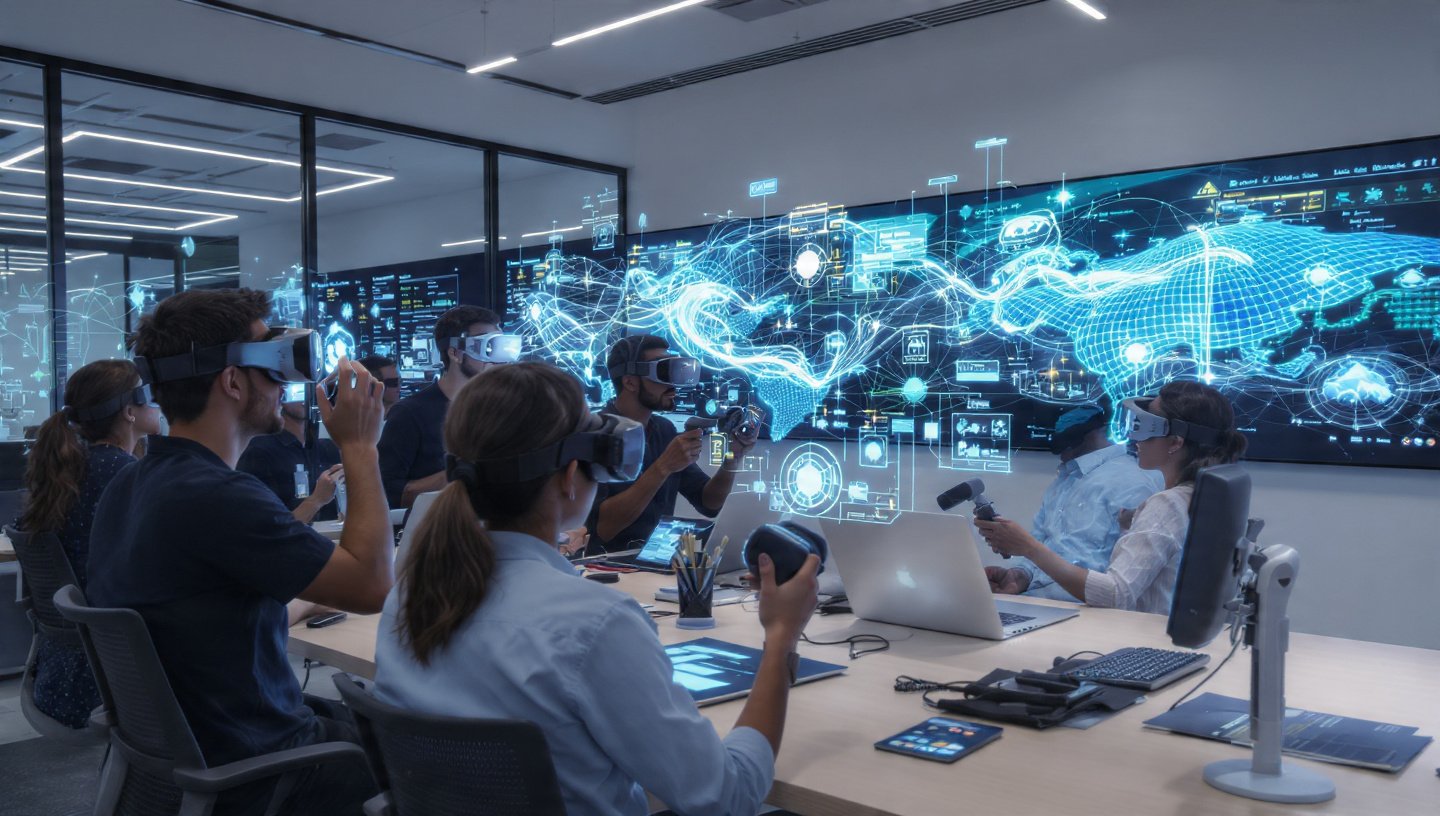
The era of regarding Virtual Reality (VR) as merely a playground for gamers is definitively over. While the consumer market continues to chase the dream of immersive entertainment, a quieter, more profound revolution is taking place behind the closed doors of the Fortune 500. In high-tech manufacturing plants, sterile surgical suites, and global boardrooms, VR is graduating from an experimental novelty to a critical infrastructure.
As we peer into the future of enterprise technology, the trajectory is clear: the one-size-fits-all approach is dying. The future belongs to bespoke, purpose-built environments. We are entering the age of hyper-specialized custom VR development, where the software is not just a tool, but a digital twin of the enterprise itself.
Beyond the “Off-the-Shelf” Illusion
For years, early adopters in the corporate world relied on off-the-shelf VR applications. These generic tools were sufficient for basic tasks—a simple virtual meeting room or a standard safety hazard walkthrough. However, as industries mature, their requirements become increasingly complex and idiosyncratic. A generic “public speaking” simulator offers little value to a trial lawyer who needs to practice specifically for the acoustics and layout of the Supreme Court.
This is where the divergence occurs. Enterprises are realizing that generic software imposes generic limitations. To gain a competitive edge, organizations are turning to custom VR architectures that mirror their unique operational DNA. The future of this development lies in precision engineering.
Imagine a logistics company with a proprietary warehouse layout. A standard VR training tool cannot replicate the specific choke points or the unique conveyor belt timing of that facility. A custom solution, however, acts as a perfect mirror. It allows new hires to build muscle memory for that specific environment before they ever step onto the concrete floor. This shift from “general skills” to “operational specificity” is the defining characteristic of the next generation of enterprise VR.
The Training Revolution: From Knowledge to Instinct
The most immediate and lucrative application of custom VR remains training, but the philosophy is shifting. We are moving beyond simple “click-and-learn” modules toward high-fidelity haptic simulations that engender instinctual competence.
In high-risk industries—aerospace, energy, defense, and healthcare—mistakes are expensive and even fatal. Custom VR allows for “consequence-free failure.” A neurosurgeon can practice a rare, high-stakes procedure on a virtual patient whose anatomy is generated from the actual MRI scans of the real patient. They can make the incision, hit a complication, fail, reset, and try again until the motion is perfect.


This is not just education; it is risk mitigation. The future of custom VR development will focus heavily on integrating physics engines that mimic the weight, resistance, and texture of real-world tools. The goal is to deceive the brain so thoroughly that the skills acquired in the headset transfer seamlessly to the physical world. We are creating a workforce that is experienced before they start their first day.
The Data Goldmine: Biometrics and Analytics
One of the most under-discussed aspects of VR is its capacity for data collection. A standard computer monitor can tell you what a user clicked. A VR headset can tell you where they looked, how long they hesitated, and even if their pupils dilated in response to stress.
Future custom VR platforms will be equipped with sophisticated analytics engines. In a retail context, a custom VR application could simulate a new store layout. By tracking the eye movement of test subjects, the software can generate heatmaps showing exactly which products grabbed attention and which were ignored.
This capability transforms VR from a presentation tool into a research lab. However, this power comes with a responsibility to implement robust privacy safeguards. The next wave of VR software development solutions will need to prioritize ethical data governance, ensuring that biometric data is anonymized and used strictly for operational optimization rather than intrusive surveillance.
Hardware Agnosticism and the Cloud
A significant bottleneck in enterprise VR adoption has been the hardware trap. Companies are hesitant to invest millions in software that runs only on a specific headset that might be obsolete in two years.
The future of custom development is hardware agnostic. Developers are shifting toward cloud-rendering technologies (Cloud XR). In this model, the heavy graphical processing is done on a powerful remote server, and the image is streamed to the headset via 5G or high-speed Wi-Fi.
This decouples the software from the hardware. It means a high-fidelity architectural visualization can run just as smoothly on a lightweight pair of smart glasses as it does on a bulky, tethered headset. This flexibility ensures that the enterprise’s investment in custom software remains viable even as the hardware landscape shifts beneath it.
The Convergence with Mixed Reality (MR)
Finally, the boundary between Virtual Reality (fully immersive) and Augmented/Mixed Reality (overlaying digital content on the real world) is dissolving. The latest headsets offer “passthrough” capabilities, allowing users to switch between total immersion and seeing their physical surroundings.
Custom enterprise development will increasingly leverage this hybrid state. A maintenance technician could wear a headset to see a fully virtual schematic of a machine (VR) to understand the theory, and then switch to passthrough mode to see digital instructions overlaid on the actual machine in front of them (MR) to perform the repair. Designing software that flows fluidly between these two modes will be a key challenge and opportunity for developers.
Conclusion
The future of enterprise VR is about enhancement. It is about stripping away the physical limitations of distance, cost, and risk that hamper business growth.
As we move forward, the successful enterprises will be those that stop viewing VR as a gadget and start viewing it as a canvas. By investing in custom, purpose-built environments, they create assets that are uniquely theirs—training programs that cannot be copied, collaborative spaces that define their culture, and data insights that are invisible to their competitors. The virtual world is open for construction, and the blueprints are being drawn today.